


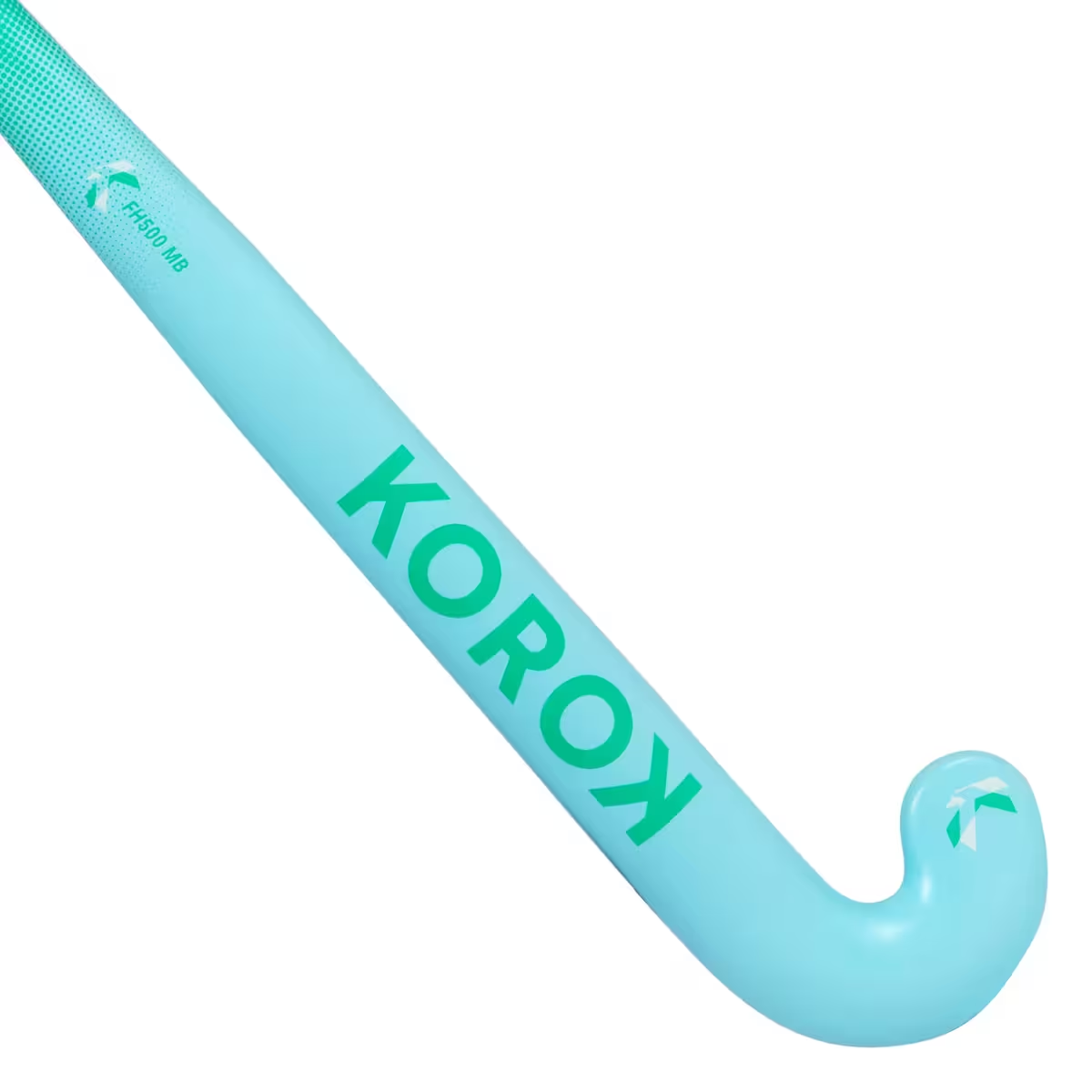



Design benefits
-
Directional control
The mid bow makes dribbling/pushing more controlled
-
Ergonomic grip
classic grip, smooth surface, held flat
-
Power
100% fibreglass and midbow provide greater power, particularly for passing
-
Ball touch
Flexible stick which properly transfers the feel of the ball at the end of it
-
Robustness
The 100% fibreglass provides more durability
-
Vibration dampening
The 100% fibreglass provides less vibration dampening
-
Ease of handling
The mid-bow curve helps you learn new movements
Design details
Composition
100% fibreglass
Bow and weight
Mid bow 24mm, 300mm; Weight: 480 g +/- 10 g for size 35"
Detailed description
1080 Tex fibreglass. Hollow twin channel structure. Standard 45° head for manoeuvrability. Polyurethane (PU) grip (1.8 mm thick) for good grip
What materials are hockey sticks made from?
While hockey sticks were traditionally made from wood (oak, mulberry), today most sticks (and especially the most technical) are made from composites (fibreglass, carbon fibre and aramid fibre; Kevlar is the brand name of a type of aramid). Sticks can be made of 100% wood, wood with fibreglass or carbon reinforcements, 100% fibreglass, or fibreglass with varying levels of carbon content
What materials are hockey sticks made from?(cont.)
(often with 5-10% aramid when the carbon % is very high)
Features and uses
Fibreglass is harder and more rigid, lightweight and abrasion resistant than wood. It will give you more power but less control and a greater feeling of hardness. Carbon is lighter and more rigid still, providing even greater power and less control if your technical skills aren't at a high level. Aramid is used in addition to carbon in the shaft to dampen vibrations. It may also be used in the heel for increased abrasion resistance.
How is a composite stick made?
A stick made of composites is made of several sheets of fibre rolled around a hollow core, which is made of one or more channels. The mix of components, the number of fibre layers and the core structure vary in the different sections of the stick and from one stick to another. The percentage of carbon alone does not tell you very much about a stick's features.
Choosing the right composition
Children just learning to play should opt for wooden sticks. As they improve, they can switch to a fibreglass stick and later to a stick with a reasonable percentage of carbon. Adult beginners can start out with a fibreglass stick. Adults at an intermediate or advanced level should choose a carbon percentage that corresponds to their playing style (their desired balance between control and power).
What is the bow on a stick?
A hockey stick is not straight but rather has a curve (called the bow). The curve varies by its maximum height (the maximum vertical space between a stick set on a flat surface and that surface) and the place where this height is at its maximum, measured from the tip of the head (called the bow position).
What is the bow on a stick?(cont.)
Traditionally, sticks had a bow height of around 15 mm and a bow position around halfway up the stick.
Types of bows
A "standard bow" is when the bow height is around 17 mm to 20 mm and the bow position is at 300 mm. A "mid bow" stick generally has a bow height of around 23 mm to 24 mm with a bow position at 300 mm. For a "low bow" stick, these measurements are usually 24 mm to 25 mm and 250 mm. An "extra low bow" stick will be 24 mm to 25 mm and 200 mm.
FIH curvature standard
According to International Hockey Federation (FIH) rules, a field hockey stick should have a bow position of at least 200 mm while the bow height is limited to 25 mm.
Choosing the right bow
Beginners should choose a standard bow. Intermediate or advanced players looking mainly for ball control, passing and shooting should choose a mid bow. Advanced players who dribble a lot and have strong 3D skills and perfect control during quick play can go for a low bow stick. For drag flicking, choose an extra low bow.
Stick weights
Most adult sticks (sizes 36.5"-37.5") weigh between 520 g and 580 g. Children's sticks start at 400 g. Stick weights may vary by 20 g to 30 g even for the same model due to manufacturing processes.
FIH weight standard
According to FIH rules, the maximum stick weight for field hockey is 737 g.
Why is balance important?
For sticks of equal weight, the way the weight is distributed across the stick is what makes the difference. The balance is the stick's centre of gravity as measured from the tip of the head. A balance closer to the handle will feel light. This makes handling easier. A balance closer to the head (called head heavy) will feel like there's more weight in the hands. This increases the stick's power.
Choosing the right weight and balance
If you need manoeuvrability, choose a lightweight stick with a higher balance. If you're looking for power, choose a heavy stick with a lower balance.
Which size?
Stick sizes are given in inches. 1" = 2.54 cm. Kid sizes generally start at 24" and go up to 35". For children, place the stick vertically with the head on the ground in front of the child (have them stand up straight). Choose a stick with a handle that comes up to the child's navel. For adults, the standard size is 36.5".
FIH size standard
According to FIH rules, a field hockey stick may not be longer than 41" (105 cm).
General advice for choosing a stick
The right stick is one with the right size, composition (and internal structure), bow, weight and balance for you.
Designer
This stick was co-designed by our product development team made up of passionate hockey players (product managers, designers, engineers, garment designers, stylists, prototype and lab technicians).
Designer (ctd)
Players from our partner clubs and our community, Decathlon's specialists in R&D and composite materials industrial processes, and one of the biggest sticks manufacturers in the world.
Information
The information here was provided by the manufacturer or observed by our teams from samples received from the manufacturer.
Segmentation
junior/intermediate/fibreglass/mid-bow
Sizes
30 | 31 | 32 | 33 | 34 | 35 |
Kommentar