




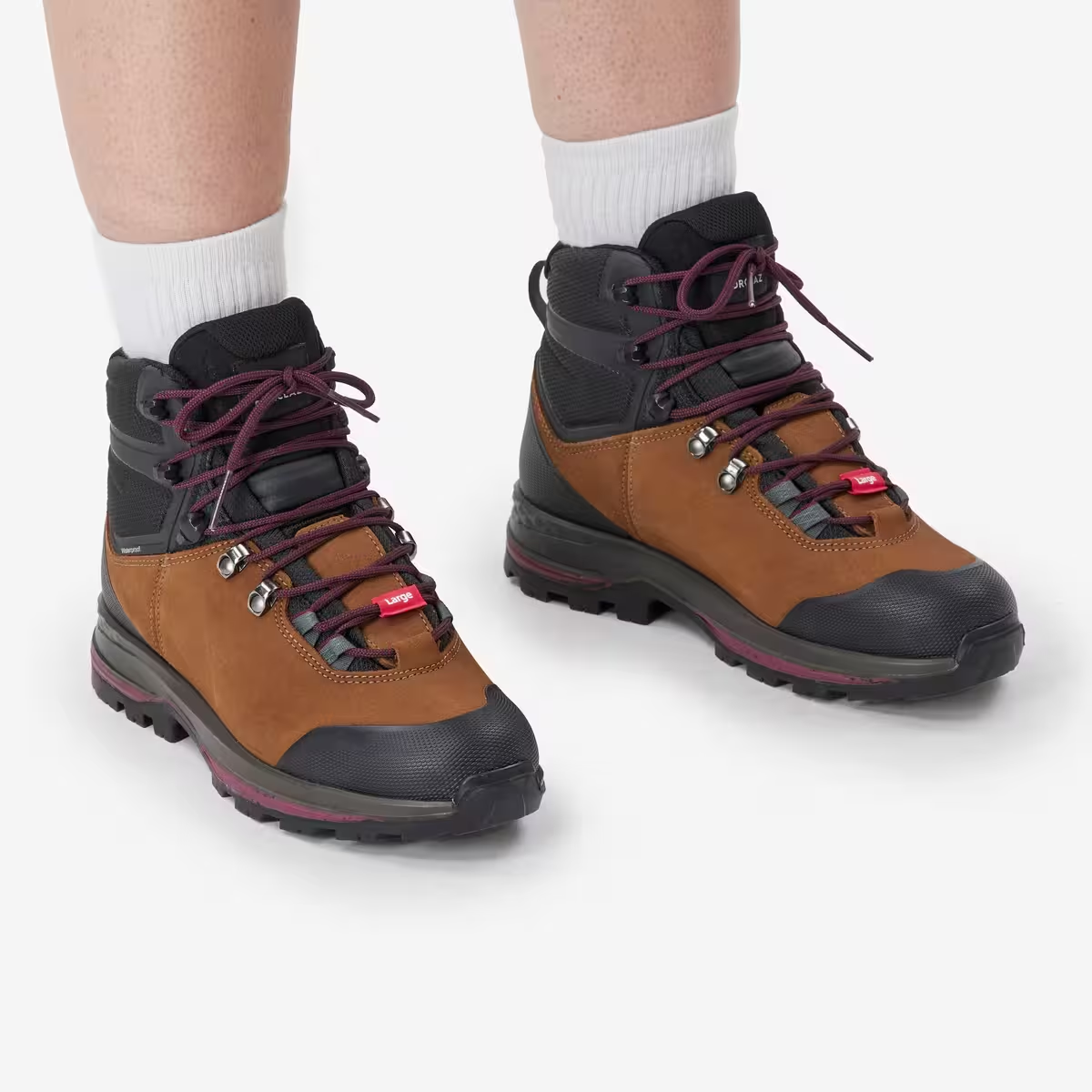


Design benefits
-
Anatomic design
Wider shape on the front foot for more comfort for larger feet
-
Foot motion
Flexible sole to improve walking, ideal for easy trail routes
-
Robustness
Leather upper and front toe bumper for greater strength and durability
-
Weight
Only 535 g per boot in size 39 (UK size 6)
-
Traction
100% approved rubber sole that improves grip and traction
-
Cushioning
Sole heal made with a cushioning material (PU)
-
Waterproof
Waterproof and breathable membrane (6 hours of walking in the rain)
-
Foot support
High upper, equipped with 2 high hooks and 1 secure blocker hook
Design details
Why offer the same model with two front width fittings?
Following an extensive study of trekker's preferences when it comes to boot shape, we decided to design a boot available in 2 different shapes: one classic, and one wide. Each inpidual can choose how much space they have inside the boots and reduce the risk of inflammation and blisters caused by badly fitting boots.
MADE IN EUROPEMANUFACTURING : 100% of our Forclaz shoes are made in Europe.
These shoes are manufactured in the European Union, in Romania, in a factory specialising in making hiking shoes (GRISPORT)
This factory exclusively uses water-based glue without chemical solvents.
Most materials are of European origin.
MANUFACTURER: https://grisport.it/company/?lang=en
Tip: copy and paste the links you find on this page into your favourite browser ;)
What kind of trails are this boot made for?
This boot is designed for trekking on generally low altitude routes and/or on trails. It can occasionally be used on more technical sections: passages over rocks, firm snow, slopes.
Benefit of the self-locking hook
With this material, you can separate the upper and lower lacing
This allows you to adjust the lacing to the shape of your foot and give your ankle as much freedom as you like. To separate the upper lacing from the lower part, make a simple knot level with your instep or use your shoes’ self-locking hook.
All of our trekking shoes have this feature.
CONTACT® technology. Grip and traction of our soles
The grip and traction of our soles is certified CONTACT®
To be awarded certification, the boots must pass laboratory tests to assess the grip rate on different surfaces (Smooth, Rugged, Dry, Wet). To validate these tests, we assess the quality of our soles in the field, the mountains, by a panel of representative testers over 500 km
Their notching also gives you grip adapted to muddy or wet terrain
Why choose a leather model? Benefits and disadvantages.
Advantages:
- supple leather.
- durable and waterproof, the leather prevents water running across the boot by repelling and absorbing it.
- breathable leather (natural pores of leather skin), but less so than a synthetic boot in strong heat. To reduce this problem, nubuck leather is used for greater breathability, but is also more sensitive to rain.
Drawbacks:
- it needs to be nourished, hydrated and treated to remain waterproof
HOW WATERPROOF ARE THESE BOOTS?
This boot has been tested and validated for 10,000 flexes repeatable, equivalent to a 15 km walk, in water reaching the mid-upper. This now guarantees a good level of boot waterproofing.
--> Our assessment indicates a LEVEL OF 3/5 giving 6 hours of waterproofing when hiking in the rain.
The details of tests carried out to assess the waterproofing of our boots is below.
How to maintain the waterproofing of your boots? It’s a question of the right accessory and a bit of elbow grease!
A waterproof grease is recommended to nourish leather to stop it drying out (cracking), to MAKE IT WATERPROOF and protect against stains.
1/ TREKKING SHOE MAINTENANCE BRUSH https://www.decathlon.co.uk/p/trekking-shoe-maintenance-brush/_/R-p-307665?mc=8551990
2 / RE-WATERPROOFING GREASE FOR LEATHER SHOES https://www.decathlon.co.uk/p/grease-for-re-waterproofing-leather-boots/_/R-p-9513?mc=8229704
Waterproof boot or gaiter? it’s not necessarily one or the other! it provides additional protection
The waterproofing of boots is often compromised because water gets in at the collar of the boot.
To keep your feet dry for longer, it is advisable to use a waterproof gaiter or mini-gaiter that will prevent water as well as pebbles and sand from getting inside through the top of the boot.
HOW TO MAINTAIN YOUR LEATHER BOOTS ? 6 steps to follow
1/ Remove the laces to avoid smearing them with grease.
2/ Dry brush them to remove dust and any particles stuck on the leather. This is essential so any dirt doesn’t get stuck under a new layer of grease.
3/ Grease the leather with a brush, rub it deep into all the seams and gaps.
4/ Wipe off the excess grease with a soft cloth.
5/ Rub gently to make them shine.
6/ Replace the laces!
How do I restore the water repellent property of my leather boots?
1/ Use a brush and/or sponge to clean the boots and remove residual earth or mud.
2/ Next, leave to air-dry, well away from a heat source.
3/ Finish by applying a water protection booster spray to maintain optimal water-repellent properties of the upper and to prolong the life span of the boot.
Link below for the applicator, also available online : https://www.decathlon.fr/p/applicateur-re-activateur-de-deperlance-pour-chaussures/_/R-p-307629?mc=8551
Which size should I select?
For hiking, do not hesitate to buy one size larger than the usual size to guarantee excellent comfort on the descent and to avoid toes rubbing at the tip of the shoe. Tip: keep your toenails short and, before descending, check that your lacing prevents your foot from sliding forwards inside the boot.
5 levels of waterproofing
During the waterproofness test, we test 5 levels of waterproofness:
- 2,000 flexes (approximately 4 km, 30 minutes of walking)
- 10,000 flexes (approximately 10 km, 3 hours of walking)
- 30,000 flexes (approximately 15 km, 6 hours of walking)
- 50,000 flexes (approximately 20 km, 8 hours of walking)
- 100,000 flexes (approximately >20 km, 24 hours of walking)
Waterproofing test
Our boots are laboratory tested by 2 consecutive tests.
Test 1: We test the effectiveness of the membrane alone immersed in water under air pressure. We simply check for any bubbles on the surface like a pierced air chamber.
Test 2: Thanks to a mechanical arm that simulates walking, the entire boots are half immersed in water and they complete thousands of flexes to check that the inside of the boot remains dry and it is therefore waterproof.
BUYING TIPS how to try on your boots?
How to choose your boots:
1. Try on both shoes, standing up, with the socks worn for hiking. 2. Tighten the laces correctly.
3. Check the following two areas of comfort: the base of the heel and the front part of the foot going down. 4. Stand up to walk with the boots on.
5. Try on several sizes and several models.
6. Gradually start using you shoes during your first few hiking trips to break them in.
Lab tests
Laboratory tests were conducted to test the following elements:
- tearing of the eyelets and straps
- bonding of the sole
- toxicology
- UV-resistance
- abrasion of the sole and components of the upper
- accelerated ageing
Kommentar